





Shopping cart is empty!
Home
Showing 8185–8196 Products of 11194 Products

The Wrong Side of Paris
Highlights:
The Wrong Side of Paris, the final novel in Balzac’s The Human Comedy, is the compelling story of Godefroid, an abject failure at thirty, who seeks refuge from materialism by moving into a monastery-like lodging house in the shadows of Notre-Dame. Presided over by Madame de La Chanterie, a noblewoman with a tragic past, the house is inhabited by a remarkable band of men—all scarred by the tumultuous aftermath of the French Revolution—who have devoted their lives to performing anonymous acts of charity. Intrigued by the Order of the Brotherhood of Consolation and their uplifting dedication to virtuous living, Godefroid strives to follow their example. He agrees to travel—incognito—to a Parisian slum to save a noble family from ruin. There he meets a beautiful, ailing Polish woman who lives in great luxury, unaware that just outside her bedroom door her own father and son are suffering in dire poverty. By proving himself worthy of the Brotherhood, Godefroid finds his own spiritual redemption. This vivid portrait of the underbelly of nineteenth-century Paris, exuberantly rendered by Jordan Stump, is the first major translation in more than a century of Balzac’s forgotten masterpiece L’Envers de l’histoire contemporaine. Featuring an illuminating Introduction by Adam Gopnik, this original Modern Library edition also includes explanatory notes.

The Yajurveda : Sanskrit text with English translation
Highlights:
Description: The Vedas are the foundation on which the imposing Hindu religious edifice is built. The Yajurveda contains hymns taken from the older Rigveda and prose passages which are new. The hymns display considerable deviation from the original Rigvedic text. It can be called a priestly manual; for it lays down rules for the performance of various sacrifices. It has two samhitas or a collection of hymns of mantras; these are Taittiriya Samhita and Vajasaneya Samhita, popularly known as Black and White Yajur respectively. The subject-matter of both the samhitas is almost the same, though the arrangement is somewhat different. Of the two the Vajasaneya Samhita is planned in a more systematic and orderly manner than the other. It also contains some texts which are not found in the Taittiriya Samhita. This translation of Yajurveda by Devi Chand is based upon Swami Dayanand’s interpretation. The translator has provided references in the footnotes to the different views of other scholars. To bring home to the common man the message of the Yajurveda, he has spared no pains to remove all obscurities inherent in the old form of Sanskrit which was in vogue three thousand years ago. The introduction and the index are added to help the reader. Everyone interested in the Vedas will find this book indispensable.

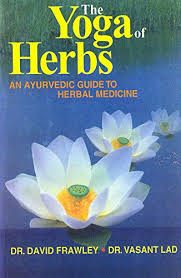
The Yoga of Herbs
Highlights:
This book offers a detailed explanation and classification of herbs,using the ancient system of Ayurveda. This fully developed and theoretically articulated medical system developed in India has proved itself effective for more than 5000 years as that country’s classical healing tradition.
More than 270 herbs are listed, with 108herbs explained in detail. Included are many of the most commonly used western herbs with a profound Ayurvedic perspective. Important Chinese and special Ayurvedic herbs are introduced. Beautiful diagrams and charts, as well asdetailed glossaries, appendices and index are included.

The Yoga of Herbs: An Ayurvedic Guide to Herbal Medicine
Highlights:
The term yoga has many traditional meanings. In Ayurveda, the medical science of India, yoga refers to the right usage and right combination of herbs. A special combination of substances designed to bring about a specific effect upon the body or mind is thus called yoga. This coordinated or integrated usage of herbs is based upon the ancient Ayurvedic science of herbal energetics. This is a system for determining the qualities and powers of herbs according to the laws of nature, so that herbs can be used objectively and specifically according to individual condition. A yogic usage of herbs implies such an harmonic application of the potencies of herbs. In this book, for the first time, this Ayurvedic herbal science is applied to western herbs, as well as to a few major oriental herbs, both Indian and Chinese. It is the purpose of this book not to present Ayurveda in the distance, as some-thing foreign or anci-ent, but to make it a practically applied syst-em of herbalism. This book is just a presentation of traditi-onal Ayurvedic know-ledge. It attempts to show living Ayurveda, its creative and practical application to changing conditions. It is meant as a bridge between east and west. In this regard, it has been a collaboration of an easterner with profound knowledge of the west and a westerner with profound knowledge of the east.
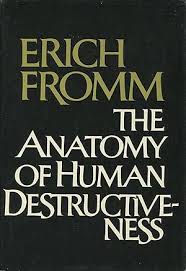
The Anatomy of Human Destructiveness
Highlights:
How can we explain man’s lust for cruelty?
In a world in which violence in every form seems to be increasing, Erich Fromm — the author of numerous best-selling books — has treated this haunting question with depth and scope in the most original and far-reaching work of his brilliant career.
Fromm goes beyond the present battle lines of controversy between instinctivists like Lorenz, who argue that man’s destructiveness has been inherited from his animal ancestors, and behaviorists like Skinner, who maintain that there are no innate human traits since everything is the result of social conditioning. Conceding that there is a kind of aggression which man shares with animals, Fromm shows that it is defensive in nature, designed to insure survival. On the other hand, malignant aggression, or destructiveness, in which man kills without biological or social purpose, is peculiarly human and not instinctive; it is part of human character, one of the passions, like love, ambition, and greed.
From this theoretical position Fromm studies
both the conditions that elicit defensive aggression and those that cause genuine destructiveness. Drawing on the most significant findings of neurophysiology, prehistory, anthropology, and animal psychology, he presents a global and historical study of human destructiveness that enables readers to evaluate the data for themselves.
Although deeply indebted to Freud, Fromm emphasizes social and cultural factors as well. Destructiveness is seen in terms of the dreams and associations of many patients and of historical figures such as Stalin — an extreme example of sadism; Himmler — an example of the bureaucratic-sadistic character; and Hitler. The analysis of Hitler, following a detailed clinical discussion of necrophilia as a form of malignant aggression, offers a detailed analytical understanding of Hitler’s character, in a masterful new form of psychobiography that is one of the high points of this brilliant book.
With the concepts of a malignant Oedipus complex and of necrophilia, Fromm revises Freud’s “death instinct” and makes a significant contribution to psychoanalytic theory. An appendix on the history of Freud’s theories on aggression will be welcome to all those who wish to know the development of the master’s thought on this subject.
Utilizing anthropological evidence, Fromm also argues that primitive societies — the hunters and food-gatherers — were the least aggressive, and that exploitation and war result from the growth of civilization and the advent of patriarchal societies.
Certain to arouse controversy because of its criticism of various contemporary doctrines, this book will nevertheless be welcomed for its solid, triumphant vindication of human dignity and for its appeal to men and women to change their lives and the social-political environment in order to create new possibilities for human growth.