



| Author | Erich Fromm |
|---|---|
| Publisher | Holt, Rinehart and Winston |
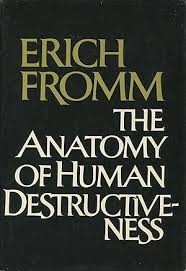
The Anatomy of Human Destructiveness
Highlights:
How can we explain man’s lust for cruelty?
In a world in which violence in every form seems to be increasing, Erich Fromm — the author of numerous best-selling books — has treated this haunting question with depth and scope in the most original and far-reaching work of his brilliant career.
Fromm goes beyond the present battle lines of controversy between instinctivists like Lorenz, who argue that man’s destructiveness has been inherited from his animal ancestors, and behaviorists like Skinner, who maintain that there are no innate human traits since everything is the result of social conditioning. Conceding that there is a kind of aggression which man shares with animals, Fromm shows that it is defensive in nature, designed to insure survival. On the other hand, malignant aggression, or destructiveness, in which man kills without biological or social purpose, is peculiarly human and not instinctive; it is part of human character, one of the passions, like love, ambition, and greed.
From this theoretical position Fromm studies
both the conditions that elicit defensive aggression and those that cause genuine destructiveness. Drawing on the most significant findings of neurophysiology, prehistory, anthropology, and animal psychology, he presents a global and historical study of human destructiveness that enables readers to evaluate the data for themselves.
Although deeply indebted to Freud, Fromm emphasizes social and cultural factors as well. Destructiveness is seen in terms of the dreams and associations of many patients and of historical figures such as Stalin — an extreme example of sadism; Himmler — an example of the bureaucratic-sadistic character; and Hitler. The analysis of Hitler, following a detailed clinical discussion of necrophilia as a form of malignant aggression, offers a detailed analytical understanding of Hitler’s character, in a masterful new form of psychobiography that is one of the high points of this brilliant book.
With the concepts of a malignant Oedipus complex and of necrophilia, Fromm revises Freud’s “death instinct” and makes a significant contribution to psychoanalytic theory. An appendix on the history of Freud’s theories on aggression will be welcome to all those who wish to know the development of the master’s thought on this subject.
Utilizing anthropological evidence, Fromm also argues that primitive societies — the hunters and food-gatherers — were the least aggressive, and that exploitation and war result from the growth of civilization and the advent of patriarchal societies.
Certain to arouse controversy because of its criticism of various contemporary doctrines, this book will nevertheless be welcomed for its solid, triumphant vindication of human dignity and for its appeal to men and women to change their lives and the social-political environment in order to create new possibilities for human growth.
Please Login to view access options.
Additional information
Reviews (0)
Be the first to review “The Anatomy of Human Destructiveness”
Related Products







There are no reviews yet.