







Shopping cart is empty!
Home
Showing 8773–8784 Products of 11194 Products

Why Is Sex Fun?
Highlights:
From the New York Times bestselling author of Upheaval, a fun and wide-ranging exploration of why human sexuality is so different from other animals’, and how it made us who we are To us humans, the sex lives of animals seem weird. But it’s our own sex lives that are truly bizarre. We are the only social species to insist on carrying out sex privately. Stranger yet, we have sex at any time, even during periods of infertility, such as pregnancy or post-menopause. A human female doesn’t know her precise time of fertility and certainly doesn’t advertise it to human males by the striking color changes, smells, and sounds used by other female mammals. Why do we differ so radically in these and other important aspects of our sexuality from our closest ancestor, the apes? Why does the human female, virtually alone among mammals, go through menopause? Why does the human male stand out as one of the few mammals to stay with the female he impregnates, to help raise the children that he sired? Why is the human penis so unnecessarily large? There is no one better qualified than Jared Diamond to explain the evolutionary forces that operated on our ancestors to make us so different sexually. With wit and a wealth of fascinating examples, Why Is Sex Fun? shows how our sexuality, as much as our large brains or upright posture, led to human’ rise in the animal kingdom.
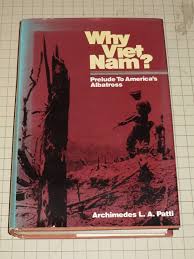
Why Viet Nam?: Preludge To America’s Albatross
Highlights:
Hardback book with dust jacket titled WHY VIETNAM? Prelude to America’s Albatross by Archimedes L.A.Patti. Published by University of California Press in 1980. Illustrated with decorated end-papers and frontispiece map. See my photographs (3) of this book on main listing page. Bookseller since 1995 (LL-Base2BS-12-bottom-L) rareviewbooks

Why Nations Fail: The Origins of Power, Prosperity and Poverty
Highlights:
Why Nations Fail answers the question that has stumped the experts for centuries: Why are some nations rich and others poor, divided by wealth and poverty, health and sickness, food and famine?
Is it culture, the weather, geography? Perhaps ignorance of what the right policies are?
Simply, no. None of these factors is either definitive or destiny. Otherwise, how to explain why Botswana has become one of the fastest growing countries in the world, while other African nations, such as Zimbabwe, the Congo, and Sierra Leone, are mired in poverty and violence?
Daron Acemoglu and James Robinson conclusively show that it is man-made political and economic institutions that underlie economic success (or lack of it). Korea, to take just one of their fascinating examples, is a remarkably homogeneous nation, yet the people of North Korea are among the poorest on earth while their brothers and sisters in South Korea are among the richest. The south forged a society that created incentives, rewarded innovation, and allowed everyone to participate in economic opportunities. The economic success thus spurred was sustained because the government became accountable and responsive to citizens and the great mass of people. Sadly, the people of the north have endured decades of famine, political repression, and very different economic institutions—with no end in sight. The differences between the Koreas is due to the politics that created these completely different institutional trajectories.
Based on fifteen years of original research Acemoglu and Robinson marshall extraordinary historical evidence from the Roman Empire, the Mayan city-states, medieval Venice, the Soviet Union, Latin America, England, Europe, the United States, and Africa to build a new theory of political economy with great relevance for the big questions of today, including:
– China has built an authoritarian growth machine. Will it continue to grow at such high speed and overwhelm the West?
– Are America’s best days behind it? Are we moving from a virtuous circle in which efforts by elites to aggrandize power are resisted to a vicious one that enriches and empowers a small minority?
– What is the most effective way to help move billions of people from the rut of poverty to prosperity? More
philanthropy from the wealthy nations of the West? Or learning the hard-won lessons of Acemoglu and Robinson’s breakthrough ideas on the interplay between inclusive political and economic institutions?
Why Nations Fail will change the way you look at—and understand—the world.

Wild Food Plants of Australia
Highlights:
Tim Low has provided a truly reliable guide to our edible flora, making identification easy. Thus it is a perfect companion for bushwalkers, naturalists, scientists and, with emphasis on wild food cuisine, gourmets. Low describes more than 180 plants – from the most tasty and significant plant foods of southern and eastern Australia to the more important and spectacular inland and tropical foods. Distribution maps are provided with each description plus notes on how these plants were used in the past and can be used today. Beautifully illustrated with colour photographs and line drawings there is also a guide to poisonous and non-poisonous plants, and information on introduced food plants, the nutrients found in wild food plants, on bush survival, and how to forage for and cook with wild plants.