





Shopping cart is empty!
Home
Showing 8305–8316 Products of 11194 Products

This is Not the End of the Book; A conversation curated by Jean-Philippe de Tonnac
Highlights:
The perfect gift for book lovers: a beautifully designed hardcover in which two of the world’s great men have a delightfully rambling conversation about the future of the book in the digital era, and decide it is here to stay.
These days it is almost impossible to get away from discussions of whether the book will survive the digital revolution. Blogs, tweets and newspaper articles appear daily on the subject, many of them repetitive, most of them admitting they don’t know what will happen. Amidst the twittering, the thoughts of Jean-Claude Carrière and Umberto Eco come as a breath of fresh air. There are few people better placed to discuss the past, present and future of the book. Both of them avid book collectors with a deep understanding of history, they have explored through their work, both written and visual, the many and varied ways in which ideas have been represented through the ages.
This beautifully produced book, an object of desire in itself, is the transcription of a long conversation between the two men in which they discuss a vast range of subjects, from what can be defined as the first book, to the idea of the library, the burning of books both accidental and deliberate, and what will happen to knowledge and memory when infinite amounts of information are available at the click of a mouse. En route there are delightful digressions into personal anecdote about everything from Eco’s first computer to the book Carrière is most sad to have sold.
Readers will close this book feeling that they have had the privilege of eavesdropping on an intimate discussion between two great minds. And while, as Carrière says, the one certain thing about the future is that it is unpredictable, it is clear from this conversation that, in some form or other, the book will survive. After all, as Eco says: like the spoon, once invented, it cannot be bettered.

This I Believe
Highlights:
In this masterly, deeply personal, and provocative book, the internationally renowned Mexican writer Carlos Fuentes, whose work has been called “a combination of Poe, Baudelaire, and Isak Dinesen” (Newsweek), steps back to survey the wellsprings of art and ideology, the events that have shaped our time, and his extraordinary life and fiercest passions.
Arranged alphabetically from “Amore” to “Zurich,” This I Believe takes us on a marvelous inner journey with a great writer. Fuentes ranges wide, from contradictions inherent in Latin American culture and politics to his long friendship with director Luis Buñuel.
Along the way, we find reflection on the mixed curse and blessing of globalization; memories of a sexual initiation in Zurich; a fond tracing of a family tree heavy with poets, dreamers, and diplomats; evocations of the streets, cafés, and bedrooms of Washington, Paris, Santiago de Chile, Cambridge, Oaxaca, and New York; and a celebration of literary heroes including Balzac, Cervantes, Faulkner, Kafka, and Shakespeare. Throughout, Fuentes captivates with the power of his intellect and his prose.
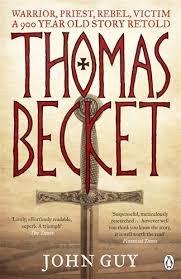
Thomas Becket
Highlights:
From Thomas Becket’s early life as a merchant’s son and his time as the Archbishop of Canterbury to his assassination in the Cathedral itself, this enlightening book brings to life a colossal figure of British history.
This is the man, not the legend . . .
Thomas Becket lived at the centre of medieval England. Son of a draper’s merchant, he was befriended and favoured by Henry II and quickly ascended the rungs of power and privilege. He led 700 knights into battle, brokered peace between warring states and advised King and Pope.
Yet he lost it all defying his closest friend and King, resulting in his bloody murder and the birth of a saint.
In award-winning biographer John Guy’s masterful account, the life, death and times of Thomas Becket come vividly into focus.

Those Barren Leaves
Highlights:
Huxley spares no one in his ironic, piercing portrayal of a group gathered in an Italian palace by the socially ambitious and self-professed lover of art, Mrs. Aldwinkle. Here, Mrs. Aldwinkle yearns to recapture the glories of the Italian Renaissance, but her guests ultimately fail to fulfill her naive expectations. Among her entourage are: a suffering poet and reluctant editor of the “Rabbit Fanciers’ Gazette” who silently bears the widowed Mrs. Aldwinkle’s desperate advances; a popular novelist who records every detail of her affair with another guest, the amorous Calamy, for future literary endeavors; and an aging sensualist philosopher who pursues a wealthy yet mentally-disabled heiress. Stripping the houseguests of their pretensions, Huxley reveals the superficiality of the cultural elite. Deliciously satirical, Those Barren Leaves bites the hands of those who dare to posture or feign sophistication and is as comically fresh today as when first published.