


Shopping cart is empty!
Home
Showing 8233–8244 Products of 11194 Products

The Handmaid’s Tale
Highlights:
A gripping vision of our society radically overturned by a theocratic revolution, Margaret Atwood’s The Handmaid’s Tale has become one of the most powerful and most widely read novels of our time.
Offred is a Handmaid in the Republic of Gilead, serving in the household of the enigmatic Commander and his bitter wife. She may go out once a day to markets whose signs are now pictures because women are not allowed to read. She must pray that the Commander makes her pregnant, for in a time of declining birthrates her value lies in her fertility, and failure means exile to the dangerously polluted Colonies. Offred can remember a time when she lived with her husband and daughter and had a job, before she lost even her own name. Now she navigates the intimate secrets of those who control her every move, risking her life in breaking the rules.
Like Aldous Huxley’s Brave New World and George Orwell’s Nineteen Eighty-Four, The Handmaid’s Tale has endured not only as a literary landmark but as a warning of a possible future that is still chillingly relevant.
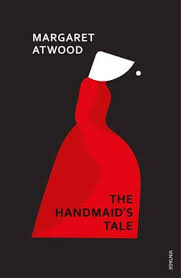
The Handmaid’s Tale
Highlights:
A gripping vision of our society radically overturned by a theocratic revolution, Margaret Atwood’s The Handmaid’s Tale has become one of the most powerful and most widely read novels of our time.
Offred is a Handmaid in the Republic of Gilead, serving in the household of the enigmatic Commander and his bitter wife. She may go out once a day to markets whose signs are now pictures because women are not allowed to read. She must pray that the Commander makes her pregnant, for in a time of declining birthrates her value lies in her fertility, and failure means exile to the dangerously polluted Colonies. Offred can remember a time when she lived with her husband and daughter and had a job, before she lost even her own name. Now she navigates the intimate secrets of those who control her every move, risking her life in breaking the rules.
Like Aldous Huxley’s Brave New World and George Orwell’s Nineteen Eighty-Four, The Handmaid’s Tale has endured not only as a literary landmark but as a warning of a possible future that is still chillingly relevant.
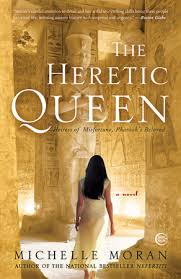
The Heretic Queen
Highlights:
n ancient Egypt, a forgotten princess must overcome her family’s past and remake history.
The winds of change are blowing through Thebes. A devastating palace fire has killed the Eighteenth Dynasty’s royal family—all with the exception of Nefertari, the niece of the reviled former queen, Nefertiti. The girl’s deceased family has been branded as heretical, and no one in Egypt will speak their names. A relic of a previous reign, Nefertari is pushed aside, an unimportant princess left to run wild in the palace. But this changes when she is taken under the wing of the Pharaoh’s aunt, then brought to the Temple of Hathor, where she is educated in a manner befitting a future queen.
Soon Nefertari catches the eye of the Crown Prince, and despite her family’s history, they fall in love and wish to marry. Yet all of Egypt opposes this union between the rising star of a new dynasty and the fading star of an old, heretical one. While political adversity sets the country on edge, Nefertari becomes the wife of Ramesses the Great. Destined to be the most powerful Pharaoh in Egypt, he is also the man who must confront the most famous exodus in history.
Sweeping in scope and meticulous in detail, The Heretic Queen is a novel of passion and power, heartbreak and redemption.

The Heretic Queen: Heiress of Misfortune, Pharaoh’s Beloved
Highlights:
n ancient Egypt, a forgotten princess must overcome her family’s past and remake history.
The winds of change are blowing through Thebes. A devastating palace fire has killed the Eighteenth Dynasty’s royal family—all with the exception of Nefertari, the niece of the reviled former queen, Nefertiti. The girl’s deceased family has been branded as heretical, and no one in Egypt will speak their names. A relic of a previous reign, Nefertari is pushed aside, an unimportant princess left to run wild in the palace. But this changes when she is taken under the wing of the Pharaoh’s aunt, then brought to the Temple of Hathor, where she is educated in a manner befitting a future queen.
Soon Nefertari catches the eye of the Crown Prince, and despite her family’s history, they fall in love and wish to marry. Yet all of Egypt opposes this union between the rising star of a new dynasty and the fading star of an old, heretical one. While political adversity sets the country on edge, Nefertari becomes the wife of Ramesses the Great. Destined to be the most powerful Pharaoh in Egypt, he is also the man who must confront the most famous exodus in history.
Sweeping in scope and meticulous in detail, The Heretic Queen is a novel of passion and power, heartbreak and redemption.

The History of Sexuality 2.
Highlights:
This book offers an account of the emergence of Christianity from the Ancient World. Here Foucault describes the stranger byways of Greek medicine (with its advice on the healthiest season for sex as well as on exercise and diet), the permitted ways of courting young boys, and the economists’ ideas about the role of women. The book abounds in insights into the differences – and the continuities – between the Ancient, Christian and Modern worlds. But Foucault does far more than merely recreate a vanished era when sex was not a major moral issue (only Plato, like Saint Paul, saw puritanical restraint as the way of wisdom), but makes us rethink all our own assumptions about sex.

The History of Sexuality 3.
Highlights:
Why has there been such an explosion of discussion about sex in the west since the 17th century? Here, one of France’s greatest intellectuals explores the evolving social, economic and political forces that have shaped our attitudes to sex. In a book that is at once controversial and seductive, Foucault describes how we are in the process of making a science of sex which is devoted to the analysis of desire rather than the increase of pleasure.
The Holy Blood and The Holy Grail
Highlights:
A nineteenth century French priest discovers something in his mountain village at the foot of The Pyrenees which enables him to amass and spend a fortune of millions of pounds. The tale seems to begin with buried treasure and then turns into an unprecedented historical detective story – a modern Grail quest leading back through cryptically coded parchments, secret societies, the Knights Templar, the Cathar heretics of the twelfth and thirteenth centuries and a dynasty of obscure French kings deposed more than 1,300 years ago. The author’s conclusions are persuasive: at the core is not material riches but a secret – a secret of explosive and controversial proportions, which radiates out from the little Pyrenees village all the way to contemporary politics and the entire edifice of the Christian faith. It involves nothing less than… the Holy Grail.

The Kill List
Highlights:
The Kill List: a top secret catalogue of names held at the highest level of the US government. On it, those men and women who would threaten the world’s security. And at the top of it, The Preacher, a radical Islamic cleric whose sermons inspire his followers to kill high profile Western targets in the name of God. As the bodies begin to pile up in America, Great Britain and across Europe, the message goes out: discover this man’s identity, locate him and take him out.
Tasked with what seems like an impossible job is an ex-US marine who has risen through the ranks to become one of America’s most effective intelligence chiefs. Now known only as The Tracker, he must gather what scant evidence there is, collate it and unmask The Preacher if he is to prevent the next spate of violent deaths. Aided only by a brilliant teenaged hacker, he must throw out the bait and see whether his deadly target can be drawn from his lair.
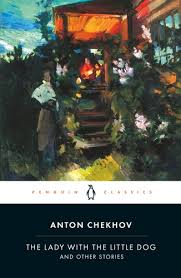
The Lady with the Little Dog and Other Stories, 1896-1904
Highlights:
In the final years of his life, Chekhov produced some of the stories that rank among his masterpieces, and some of the most highly-regarded works in Russian literature. The poignant ‘The Lady with the Little Dog’ and ‘About Love’ examine the nature of love outside of marriage – its romantic idealism and the fear of disillusionment. And in stories such as ‘Peasants’, ‘The House with the Mezzanine’ and ‘My Life’ Chekhov paints a vivid picture of the conditions of the poor and of their powerlessness in the face of exploitation and hardship. With the works collected here, Chekhov moved away from the realism of his earlier tales – developing a broader range of characters and subject matter, while forging the spare minimalist style that would inspire such modern short-story writers as Ernest Hemingway and William Faulkner.
In this edition Ronald Wilks’s translation is accompanied by an introduction in which Paul Debreczeny discusses the themes that Chekhov adopted in his mature work. This edition also includes a publishing history and notes for each story, a chronology and further reading.

The Land of Green Plums
Highlights:
Set in Romania at the height of Ceausescu’s reign of terror, “The Land of Green Plums” tells the story of a group of young students, each of whom has left the impoverished provinces in search of better prospects in the city. It is a profound illustration of a totalitarian state which comes to inhabit every aspect of life; to the extent that everyone, event the strongest, must either bend to the oppressors, or resist them and perish.

The Legacy of Islamic Antisemitism: from Sacred Texts to Solemn History
Highlights:
This comprehensive, meticulously documented collection of scholarly articles presents indisputable evidence that a readily discernible, uniquely Islamic antisemitism – a specific Muslim hatred of Jews – has been expressed continuously since the advent of Islam. Debunking the conventional wisdom, which continues to assert that Muslim animosity toward Jews is entirely a 20th-century phenomenon fueled mainly by the protracted Arab-Israeli conflict, leading scholars provide example after example of antisemitic motifs in Muslim documents reaching back to the beginnings of Islam. The contributors show that the Koran itself is a significant source of hostility toward Jews, as well as other foundational Muslim texts including the hadith (the words and deeds of Muhammad as recorded by pious Muslim transmitters) and the sira (the earliest Muslim biographies of Muhammad). Many other examples are adduced in the writings of influential Muslim jurists, theologians, and scholars, from the Middle Ages through the contemporary era. These primary sources, and seminal secondary analyses translated here for the first time into English – such as Hartwig Hirschfeld’s mid-1880s essays on Muhammad’s subjugation of the Jews of Medina and George Vajda’s elegant, comprehensive 1937 study of the hadith – detail the sacralized rationale for Islam’s anti-Jewish bigotry. Numerous complementary historical accounts illustrate the resulting plight of Jewish communities in the Muslim world across space and time, culminating in the genocidal threat posed to the Jews of Israel today.