





Shopping cart is empty!
Home
Showing 457–468 Products of 11194 Products
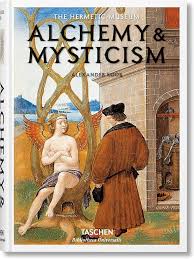
Alchemy & Mysticism
Highlights:
A fantastic journey through the history of esoteric lore
The Hermetic Museum takes readers on a magical mystery tour spanning an arc from the medieval cosmogram and images of Christian mysticism, through the fascinating world of alchemy to the art of the Romantic era. The enigmatic hieroglyphs of cabalists, Rosicrucians, and freemasons are shown to be closely linked with the early scientific illustrations in the fields of medicine, chemistry, optics, and color theory. Even for those with no knowledge of the fascinating history of alchemy, this book is a delight to explore. Each richly illustrated chapter begins with an introduction and quotes from alchemists by specialist Alexander Roob. The roots of surrealism and many other more recent artistic movements can be found in this treasure trove.

Alchemy & Mysticism (2 copies)
Highlights:
A fantastic journey through the history of esoteric lore
The Hermetic Museum takes readers on a magical mystery tour spanning an arc from the medieval cosmogram and images of Christian mysticism, through the fascinating world of alchemy to the art of the Romantic era. The enigmatic hieroglyphs of cabalists, Rosicrucians, and freemasons are shown to be closely linked with the early scientific illustrations in the fields of medicine, chemistry, optics, and color theory. Even for those with no knowledge of the fascinating history of alchemy, this book is a delight to explore. Each richly illustrated chapter begins with an introduction and quotes from alchemists by specialist Alexander Roob. The roots of surrealism and many other more recent artistic movements can be found in this treasure trove.

Alexander the Great
Highlights:
In the first authoritative biography of Alexander the Great written for a general audience in a generation, classicist and historian Philip Freeman tells the remarkable life of the great conqueror. The celebrated Macedonian king has been one of the most enduring figures in history. He was a general of such skill and renown that for two thousand years other great leaders studied his strategy and tactics, from Hannibal to Napoleon, with countless more in between. He flashed across the sky of history like a comet, glowing brightly and burning out quickly: crowned at age nineteen, dead by thirty-two. He established the greatest empire of the ancient world; Greek coins and statues are found as far east as Afghanistan. Our interest in him has never faded. Alexander was born into the royal family of Macedonia, the kingdom that would soon rule over Greece. Tutored as a boy by Aristotle, Alexander had an inquisitive mind that would serve him well when he faced formidable obstacles during his military campaigns. Shortly after taking command of the army, he launched an invasion of the Persian empire, and continued his conquests as far south as the deserts of Egypt and as far east as the mountains of present-day Pakistan and the plains of India. Alexander spent nearly all his adult life away from his homeland, and he and his men helped spread the Greek language throughout western Asia, where it would become the lingua franca of the ancient world. Within a short time after Alexander’s death in Baghdad, his empire began to fracture. Best known among his successors are the Ptolemies of Egypt, whose empire lasted until Cleopatra. In his lively and authoritative biography of Alexander, classical scholar and historian Philip Freeman describes Alexander’s astonishing achievements and provides insight into the mercurial character of the great conqueror. Alexander could be petty and magnanimous, cruel and merciful, impulsive and farsighted. Above all, he was ferociously, intensely competitive and could not tolerate losing—which he rarely did. As Freeman explains, without Alexander, the influence of Greece on the ancient world would surely not have been as great as it was, even if his motivation was not to spread Greek culture for beneficial purposes but instead to unify his empire. Only a handful of people have influenced history as Alexander did, which is why he continues to fascinate us.

Alexander the Great
Highlights:
Arrian’s account of Alexander’s life and campaigns, published as the Anabasis and its companion piece the Indica, is our prime source for the history of Alexander, told with great narrative skill. This edition features a new translation of both texts, introduction, notes, guide to military systems and terminology, maps and a full index.

Alexander the Great
Highlights:
Tough, resolute, fearless, Alexander was a born warrior and ruler of passionate ambition who understood the intense adventure of conquest and of the unknown. When he died in 323 BC aged thirty-two, his vast empire comprised more than two million square miles, spanning from Greece to India. His achievements were unparalleled – he had excelled as leader to his men, founded eighteen new cities and stamped the face of Greek culture on the ancient East. The myth he created is as potent today as it was in the ancient world. Robin Lane Fox�s superb account searches through the mass of conflicting evidence and legend to focus on Alexander as a man of his own time. Combining historical scholarship and acute psychological insight, it brings this colossal figure vividly to life.

Alexander the great
Highlights:
His passion was for glory only, and in that he was insatiable’
Although written over four hundred years after Alexander’s death, Arrian’s Campaigns of Alexander is the most reliable account of the man and his achievements we have. Arrian’s own experience as a military commander gave him unique insights into the life of the world’s greatest conqueror. He tells of Alexander’s violent suppression of the Theban rebellion, his total defeat of Persia, and his campaigns through Egypt, India and Babylon – establishing new cities and destroying others in his path. While Alexander emerges from this record as an unparalleled and charismatic leader, Arrian succeeds brilliantly in creating an objective and fully rounded portrait of a man of boundless ambition, who was exposed to the temptations of power and worshipped as a god in his own lifetime.
Aubrey de Sélincourt’s vivid translation is accompanied by J. R. Hamilton’s introduction, which discusses Arrian’s life and times, his synthesis of other classical sources and the composition of Alexander’s army. The edition also includes maps, a list for further reading and a detailed index.
For more than seventy years, Penguin has been the leading publisher of classic literature in the English-speaking world. With more than 1,700 titles, Penguin Classics represents a global bookshelf of the best works throughout history and across genres and disciplines. Readers trust the series to provide authoritative texts enhanced by introductions and notes by distinguished scholars and contemporary authors, as well as up-to-date translations by award-winning translators.